In this team spotlight, we get to know David Fournier as he shares his journey across startups and insights into his current role as a software developer at a data annotation platform.
David: Although I got my degree in signal processing, I’ve worked as a software engineer at many fascinating companies. However, my internship at Thales may be the most related to what we do at Segments.ai. I worked on a 3D application to simulate the echo of a radar so we could test algorithms, such as detecting and locating boats from an airplane.
After working at Datacamp for almost three years, I joined Urbantz, a B2B SaaS product for last-mile delivery. In both cases, the most challenging task was keeping the platform running smoothly. For example, for Urbantz, any platform issues meant drivers couldn’t start their rounds, causing significant disruptions.
At Offered.ai, we developed a tool to help job applicants customize their resumes for specific job descriptions. We worked with LLMs such as ChatGPT to generate professional and truthful resumes, as overly fabricated resumes wouldn’t help applicants in the long run.
What I like about working at smaller companies is that they require efficiency due to their small team sizes and tight budgets. This necessity eliminates unnecessary work and keeps everyone focused on impactful tasks. I enjoy being in an environment where my work feels significant and where I can understand the product deeply. For example, Intel laid off 15,000 people, which shows how large companies can become inefficient.
What I have found unique at Segments.ai is the close interaction between developers and end customers. We have a Slack channel with our customers that allows direct interaction. For instance, the Focus Beam feature came directly from customer feedback, and we continually refine our ideas based on user input to ensure we build valuable features.
Every feature we develop benefits from customer feedback. For example, with the Focus Beam feature, we worked closely with Nuro to understand their needs and ensure it was helpful. This process involves gathering feedback, refining the proposal, and ensuring it benefits all users, not just the requesting customer.
On segments.ai, you get to annotate images and point cloud data in a single interface. But it can still be challenging to locate something obviously visible on an image – e.g., a traffic sign or a cone – in a point cloud.
The feature helps users locate objects within a 3D point cloud using images. You first click on an object in a picture. And on the point cloud, you will see a line drawn from the ego vehicle traversing that point. If you follow the line, you will come across the object you’re looking for and can annotate it.
It was a great project to work on, but figuring out the correct 3D translations and rotations and switching between 2D and 3D was challenging.
I’m not particularly passionate about data annotation itself. I annotated data a few times and quickly realized how tedious it is. But I find the technical challenges of building a user-friendly tool exciting and making the process as easy and fast as possible for our users. My previous experience with 3D applications and signal processing has been practical here, especially transitioning from MATLAB to new technologies like Three.js for web applications.
I do have a passion for our customers. I’m particularly interested in how autonomous systems can enhance safety. My neighbor works at Blooloc on self-driving vehicles, focusing on safety, detecting unexpected objects, and preventing accidents. Eliminating repetitive work by robots is also an example of safety. Too many people die because repetitive work makes them tired and less attentive, causing them to make deadly mistakes. Innovations that enhance safety in such a practical way are inspiring. The company Dexterity is such an example.
I do have my doubts about self-driving cars in combination with human drivers. Think, for example, about Place de l’Étoile in Paris. As an autonomous vehicle today, you cannot respect the rules and cross that roundabout. It’s impossible. Another challenge is that today’s society can accept human errors, but they don’t accept robot errors. Even if you can prove that you will have fewer accidents with robots. So today, I am instead a fan of assisting drivers to increase safety.
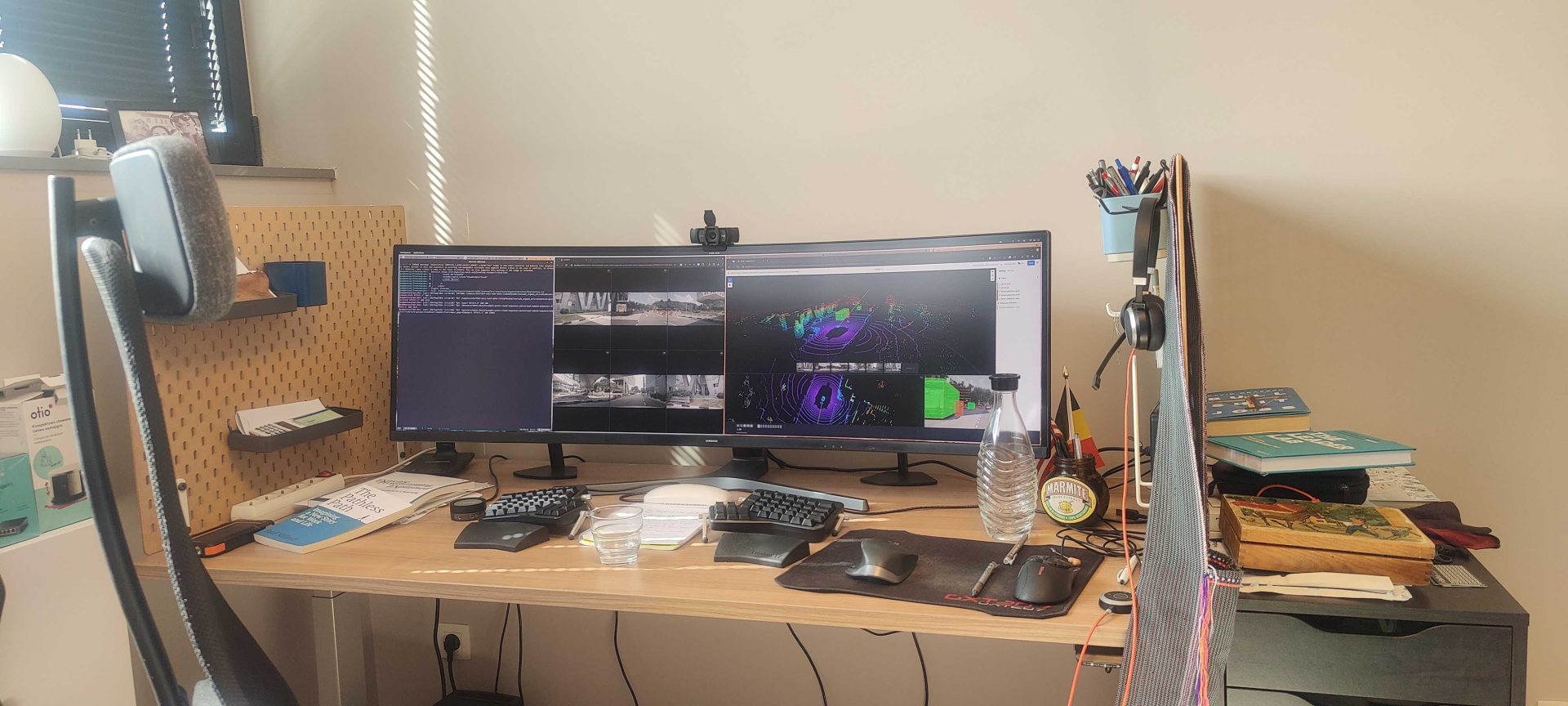
I thrive in a remote work environment. It offers flexibility and minimizes distractions, crucial for focusing on complex tasks. A dedicated workspace at home helps maintain a clear boundary between work and personal life, enhancing productivity.
In general, I have the same gadgets most developers have. The one thing that stands out is that I have a mechanical keyboard split into two halves. It is unusual but very comfortable and reduces wrist strain. My keyboard and keystrokes are orthogonal, meaning I need to move my fingers up and down. Traditional keyboards have shifted rows. But that is a legacy of old typewriters, to avoid the two mechanical branches from touching each other. It’s weird that we still see this in any modern computer. For anyone interested, you can find them here > https://ergodox-ez.com/.
Not having to rush to work also gives me more time to enjoy my coffee. I don’t drink coffee to wake up; I wake up to drink coffee. I enjoy preparing my coffee as much as drinking it. Grinding beans and using a good pour-over technique to get the perfect smell and taste is something I really like.