





Navigate the depths accurately and efficiently with precision data labeling
In challenging underwater environments, where data noise and resolution can be significant barriers, multi-sensor data labeling facilitates labeling significantly for AUV navigation and object detection. Assure your underwater vehicles discern entities adeptly, from identifying specific objects with known dimensions to safely navigating through the enigmatic underwater realm, prioritizing optimal mission success and AUV safeguarding.

Steadily maneuver through mystifying underwater environments by:
Consistent object ID: Maintain object IDs across multiple underwater sensors, ensuring your ML models recognize entities consistently even when there is a considerable amount of noise.
Maximized efficiency: Reduce time-to-deployment with minimal reconciliation and amplified model precision.
Occlusion management: Manage data obscurities and maintain object tracking even amidst the murky and tumultuous underwater terrains.
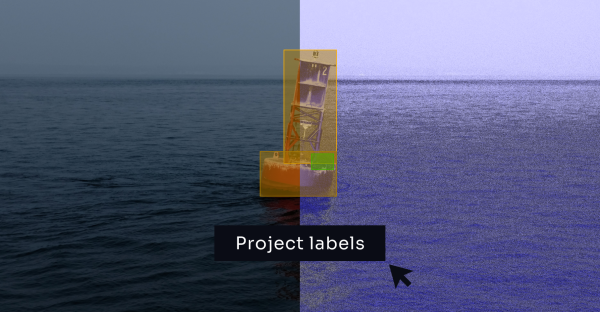
Speed up your data labeling process for complex underwater environments by pre-labeling multiple sensors with 1 click.
Efficient labeling: Easily transition between 3D to 2D data with a single click, attaining pre-labeled datasets requiring minimal adjustments.
Consistent labeling count: Ensure no objects are missed across low-resolution point clouds and images with 3D to 2D projections.

Empower your ML models for UAV with the capability to navigate safely and efficiently through the obscured underwater terrains.
Augmented labeling context: Combine 2D and 3D sensor data, simplifying object differentiation and precise labeling.
Smart labeling workflows: Get consistent annotations by enabling a single labeler to annotate all data for a single sequence across all sensors.
Accurate object classification: Ensure correct object classification for your project for sonars and images, even when visibility is low.
Label all your sensor’s data in one interface


Label fast, accurate and efficiently with ML-assisted features build for and by machine learning teams.


