Justin Bériot’s career began far from the tech world. His first job was as a postman. Despite having no formal training, he taught himself coding and started building websites for small businesses. Over time, he transitioned to e-commerce platforms and game development, where he explored 3D modeling and spatial data. Now, Justin brings technical expertise and an inquisitive approach to solving problems in data annotation and machine learning.
Learning Through Real-World Problems
Throughout his career, it has always been about solving practical challenges for Justin. At a last-mile logistics startup in Belgium, he served as CTO, leading efforts to optimize delivery routes.
“For us, last-mile logistics was like an optimization tool,” Justin explains. “You have 10 trucks, 10 drivers, and 100 packages to deliver. You put everything in the system, click a button, and we create the rounds for you. Drivers get their routes on their phones and follow them. It was about cost efficiency and reducing CO₂ emissions by minimizing kilometers driven.”
After Urbantz, Justin joined DataCamp. There, he led a small team building a two-sided marketplace. “We started from scratch,” Justin says. “I was responsible for engineering, product design, and go-to-market strategy. I learned a lot.” Here, Justin gained valuable experience developing user-friendly products.
His next role at Offered.ai deepened his understanding of user needs and AI tools. “It was a hybrid role. I discussed the platform with users, listened to their needs, and built features to help improve their job applications and resumes.”
These experiences paved the way for his interest in data annotation in AI applications.
A New Chapter at Segments.ai
The move to Segments.ai by Justin came from a desire to learn and grow alongside experienced leaders. “A friend told me Otto was one of the smartest people he knew. So if someone told me something like this, that triggers my curiosity,” Justin says, explaining why he chose to join the company.
Learning further about Segments.ai, Justin liked the company’s dedication to maintaining close customer relationships. “I think what impressed me on the business side is the very close relationship that Segment has with the customers. We have dedicated Slack channels with customers, regular check-ins, and personally meet clients at conferences.”
Collaborating with Otto and Bert has given Justin valuable insights into leadership and product development. He reflects, “It’s not about doing everything at once but doing the right things at the right time.” This, coupled with the Segments team’s focus on building useful tools for real users, makes the experience rewarding.
Improving Data Annotation Workflows
Before joining us here at Segments.ai, Justin wasn’t familiar with data annotation. “No, I didn’t know it was a thing,” he openly admits. However, he quickly grasped its importance in training AI systems.
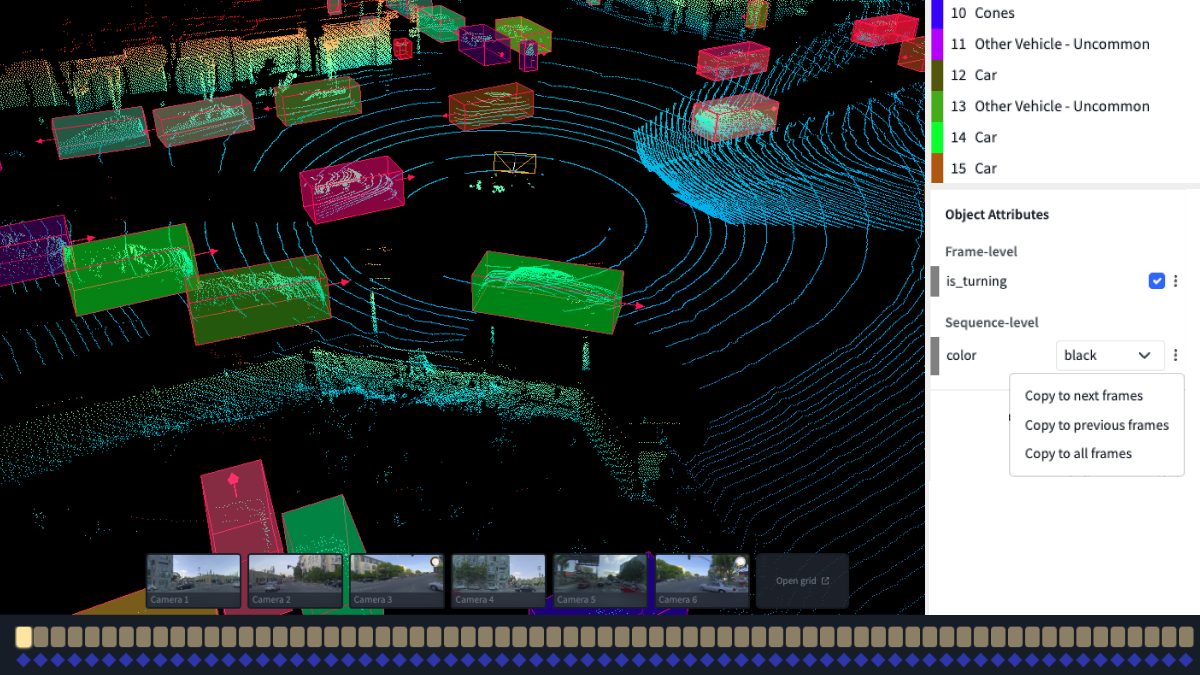
One of Justin’s key contributions has been enhancing annotation workflows. He has helped develop a feature allowing attributes to propagate across frames in a sequence.
“Imagine an object appears across several frames. Instead of labeling it frame by frame, you can apply the same attribute to all frames with a single action,” he explains. “This also works across sensors, like cameras and lidar.”
These improvements have been particularly valuable for multimodal datasets with overlapping data. By reducing repetitive tasks, Justin’s updates enable annotators to concentrate on higher-value work, improving speed and accuracy.
Inspiration from AI Applications and Vision for the Future
Justin finds AI’s possibilities inspiring. He recalls a demo in Berlin of a self-driving Formula One car equipped with advanced high-speed lidar sensors. “The speed and precision were incredible,” Justin says, “Autonomous systems have to process information so much faster in these cases, which brings its own set of challenges.”
There is similar potential in agriculture, according to Justin. He mentions the use of AI technologies like autonomous tractors. “The challenge is to build tools that help farmers harvest more efficiently. It’s exciting to think about how machines can handle tasks more sustainably,” he notes. This mix of multi-sensor data and creative tools makes him hopeful about AI’s future.
Building for the End User Design Philosophy
In his previous roles, Justin often dealt with a disconnect between decision-makers and end users, which is similar to the case at Segments.ai.
For instance, in logistics, the individuals purchasing a route-optimization solution aren’t the ones on the ground using it daily. Although at Segments.ai, machine learning teams annotate datasets initially, this is often outsourced to data-labeling workforces.
Direct user feedback has supported many of Justin’s improvements. “We listened to their frustrations and built solutions that solved real problems,” he explains. Features like bulk attribute applications directly address pain points.
Inside Justin Bériot’s Workspace
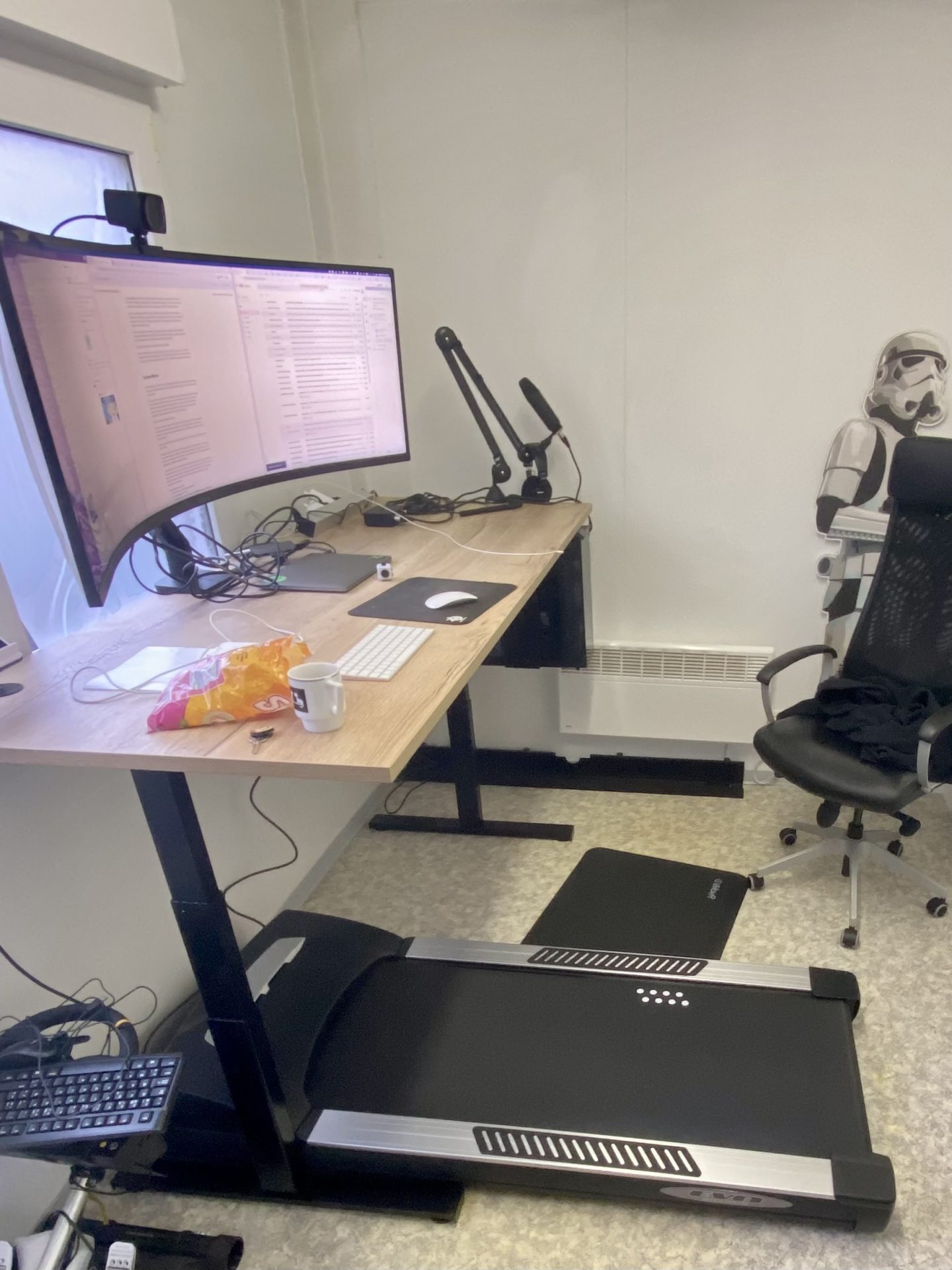
As a remote worker, Now working at a fully remote company, Justin has created a workspace custom to his needs. His setup includes a treadmill desk, ergonomic tools, and a mechanical keyboard. Books and notebooks scattered across the room create what he calls a “semi-organized mess.”
The treadmill desk allows Justin to stay active during long work sessions. “Walking helps me think clearly,” he says. He relies on a blend of movement and focus to boost productivity.
Justin begins his days with a glass of orange juice to keep his energy up. He switched from coffee. “I didn’t want to rely on caffeine,” he shares. “Small changes like this keep me balanced and focused.”
AI as a Thinking Partner in Work and Life
Justin uses AI to enhance his productivity but not as a replacement for human creativity. “I don’t rely on AI to write for me,” he explains. Instead, he sees it as a thinking partner for refining ideas and identifying potential flaws in his logic. Recently, he began using voice AI models to brainstorm while walking, which has helped him deepen his thoughts through conversational prompts.
For practical tasks, Justin uses AI for code refactoring and writing assistance, which helps him save time on routine adjustments. However, he emphasizes the importance of maintaining a personal touch in his work. “I still want it to sound like me,” he notes. In his view, AI is there to assist but not overshadow the human element in his role.
Driving Innovation at Segments.ai
By improving workflows and exploring new approaches to data annotation, 3D labeling, and multimodal systems, Justin is shaping the future of artificial intelligence solutions. His work simplifies tasks and helps industries discover new possibilities.
“The best tools make people’s jobs easier and more meaningful.”