

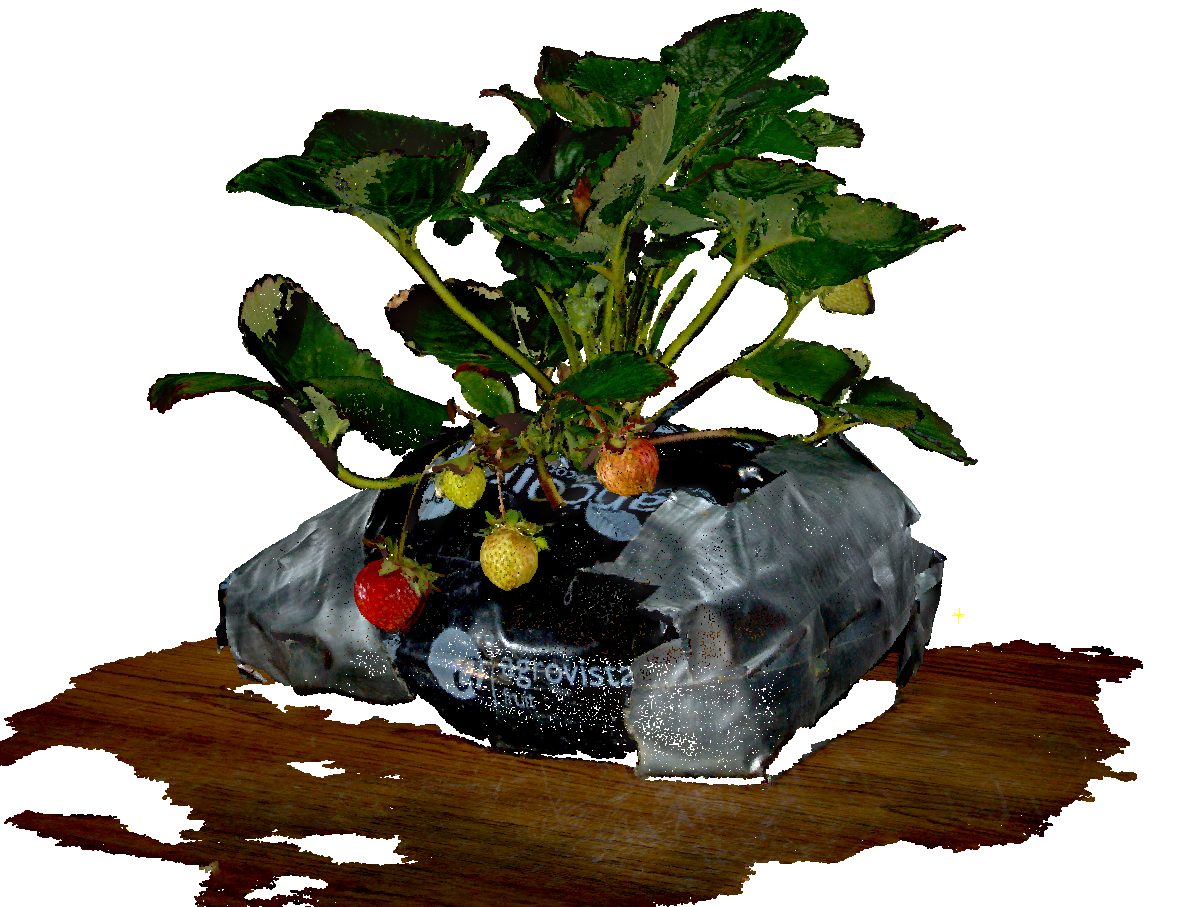
Overview
Annotation-rich 3D crop data is essential for the development of next generation automated phenotyping and crop monitoring methodology. This dataset thus provides an invaluable resource for computer vision engineers and researchers. LAST-Straw contains scans of two varieties of strawberries (3 individuals each) taken across a season, capturing plant growth and organ development from young to mature fruiting plant. Annotations provided are at both a semantic and instance level.
An example use of the dataset include its benchmarking in automated phenotyping (James et al., 2024a), and evaluation of stem skeletonisation algorithms (James et al., 2024b).
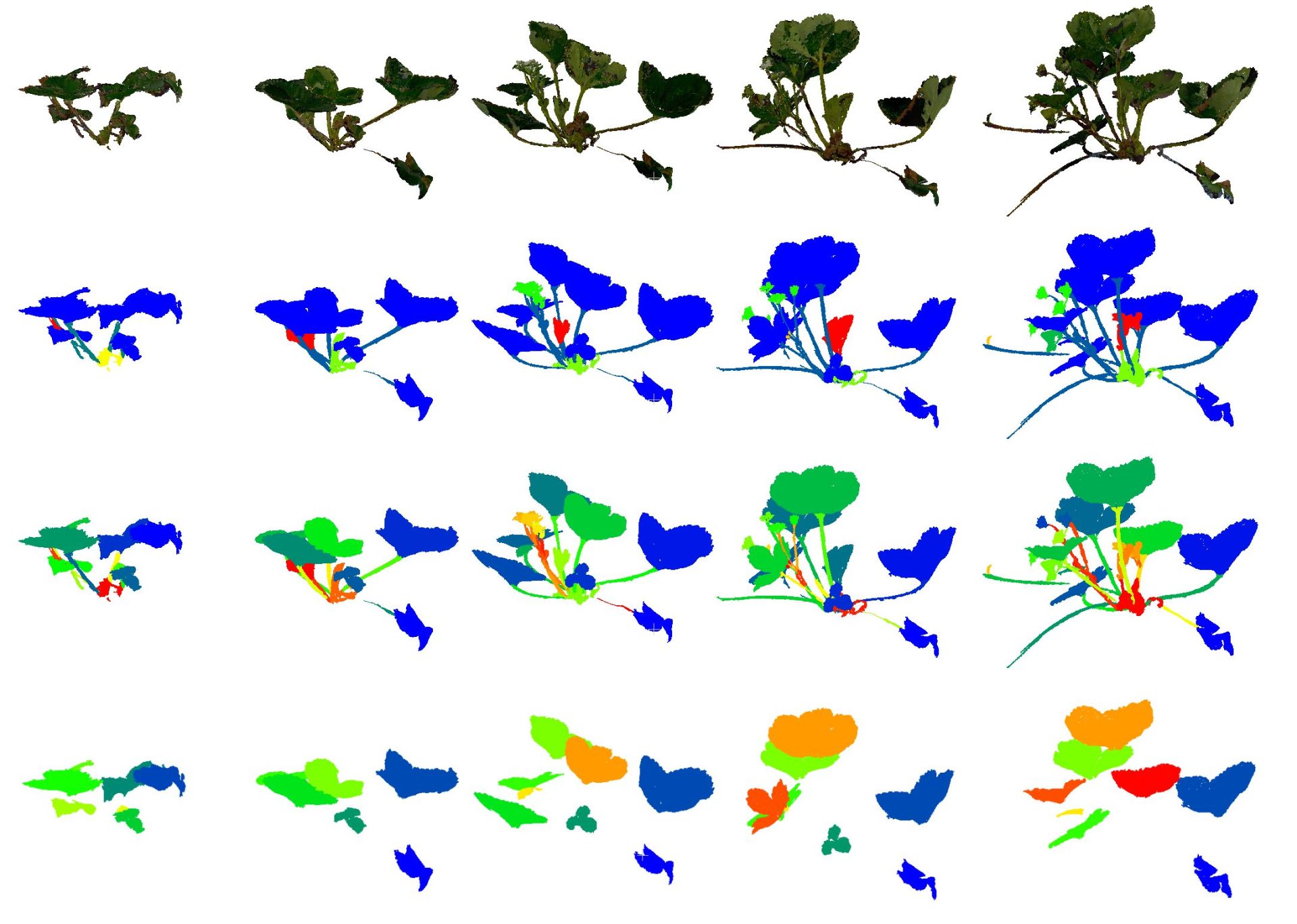
Figure 1: LAST-Straw data preview: example time series of the same plant with original textures (row 1), class annotations (row 2), instance annotations (row 3), and temporally consistent leaf instance annotations (row 4).
Data collection
Point clouds were collected in a controlled environment using a structured light camera (Shining Einscan Pro 2X). The scanner was calibrated before each use. All scans are true to real-world scale (in mm). Each sequence of scans of the same plant were aligned manually using CloudCompare, and thus a common global coordinate frame between different plants can not be assumed.
Annotations
Where available, two labels are provided per point: one class label and one instance label to distinguish individual organ instances of the same class. Please note that the instance labels are not ordered by emergence date of each organ and not temporally consistent. We use seven classes to distinguish different plant organs and two additional classes for background information inadvertently captured during the scanning process.
The semantic classes are:
- leaf or leaflet
- stem (incl. petiole, peduncle, pedicel, and stolon)
- berry
- flower
- crown
- background (incl. soil, grow bags, neighbouring plants, and any other objects captured in the background)
- other (any unidentifiable structure within the plant, which may include newly emerging organs that are not yet identifiable)
- the scanning table
- emergent leaf or leaflet
Preview and usage
You can preview a sample of the LAST-Straw dataset on Segments.ai: https://app.segments.ai/gcielniak/LAST-Straw_sample/.
To access the full dataset as well as bonus material (supporting code, stem skeletons), please see the website: https://lcas.github.io/LAST-Straw.
Publications and citations
If you use this dataset in your work, please cite:
- James, K.M.F, Heiwolt, K., Sargent, D.J. and Cielniak, G., (2024), Lincoln’s Annotated Spatio-Temporal Strawberry Dataset (LAST-Straw), In Proc. of the 9th workshop on Computer Vision Problems in Plant Phenotyping and Agriculture, Milan, 29 September (in press)
Related publications:
- James, K.M.F and Cielniak, G., (2024), Unsupervised clustering with geometric shape priors for improved occlusion handling in plant stem phenotyping, In Proc. of the 25th Towards Autonomous Robotic Systems (TAROS) Conference, Brunel, London, August 2024, 334-345, (in press)

