

In the fast-evolving world of computer vision technology, there’s always a tale of innovation waiting to be told. At the forefront of merging heritage with technology, a Ca’ Foscari University of Venice team presented their paper at the E-Heritage workshop of ICCV 2023 (The International Conference on Computer Vision).
This research is the collective effort of Aref Enayati, Luca Palmieri, Sebastiano Vascon, Marcello Pelillo, and Sinem Aslan, which is a part of the EU RePAIR project (grant agreement No.964854).
The research delves deep into the nuances of heritage restoration. Central to their methodology was semantic data labeling.
Discover how the past meets the future. And how technology is helping in our understanding of history.
Solution
The challenge is to understand broken artifact imagery using semantic segmentation. Critical details are extracted for easier classification and reassembly by zeroing in on fresco fragments.
A new dataset and baseline models were crafted with data from Pompeii’s Archaeological Site.
Additionally, Sinem and her team introduce a supplementary task of fragment cleaning. This resulted in a dataset for detecting manual annotations of archaeological marks that require restoration before further analysis.
The results prove that such detailed analysis of fresco fragments is not only possible but paves the way for advanced future studies.
For a deeper dive, the full paper on the project is available for an in-depth read. A clear video offers a straightforward visualization of their work. Additionally, two valuable datasets are provided for fragment processing tasks.
Data labeling insights
“We used Segments.ai to create pixel-wise semantic segmentation masks for a collection of images of fresco fragments. These masks aimed to categorize different fresco motifs within the images.”
Three teammembers were involved in the labeling process, and one reviewed all labeling outputs.
The reviewing tool from Segments.ai helped unify the labeling of different people and achieve consistency among annotators.
The polygon annotation tool was predominantly used due to the particular nature of the images – the images of aged ancient wall paintings from Pompeii with various forms of deterioration and color fading.
Zooming in and out and adjusting brightness levels was particularly beneficial in distinguishing motif regions.
Additionally, the statistical exploration and insight tools within Segments.ai were used.
All of the resources are accessible directly on the project page. Dive in to see the merger of heritage and technology firsthand.
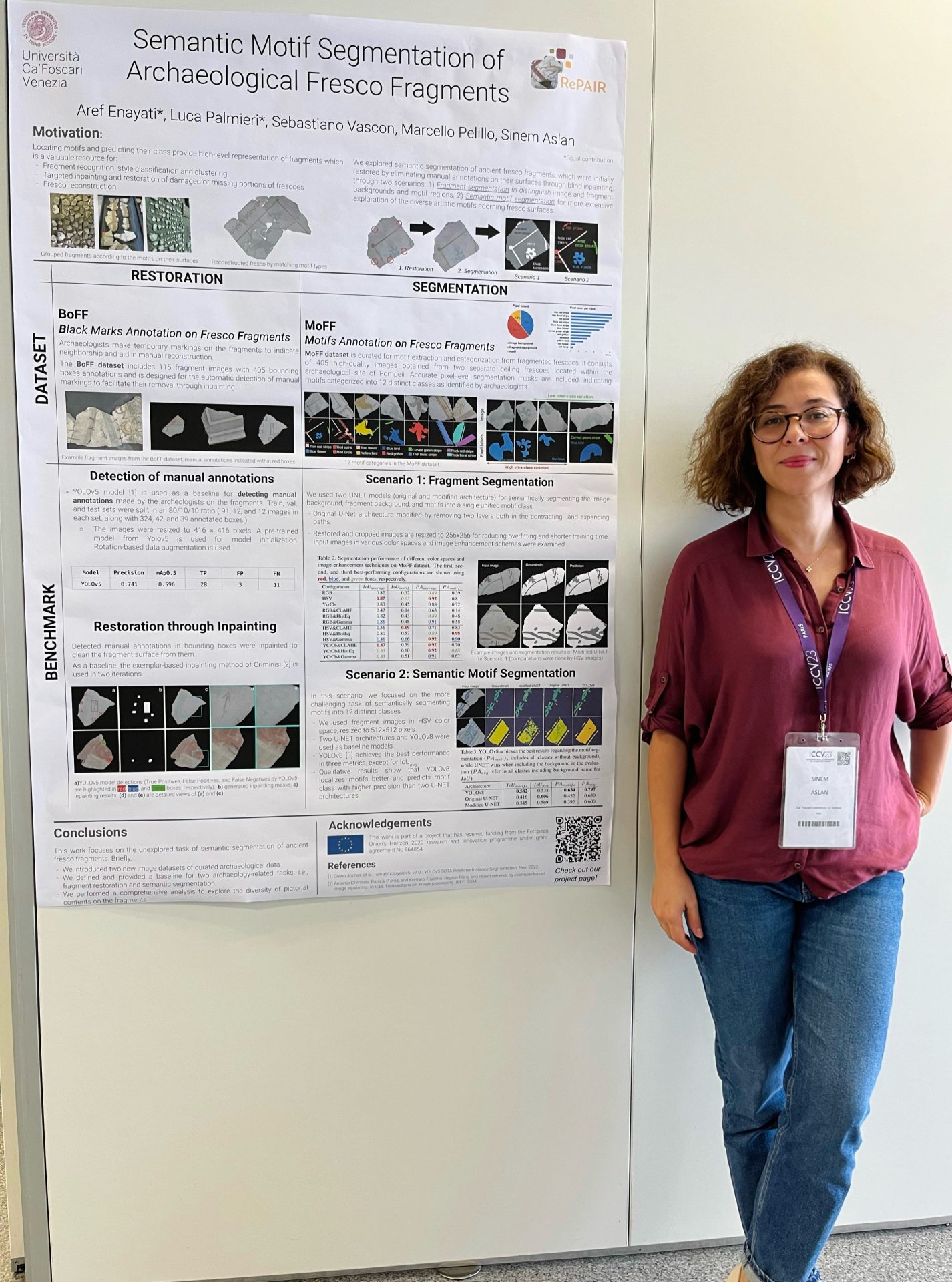
Source: Sinem Aslan with the ICCV paper on Semantic Motif Segmentation of Archaeological Fresco Fragments


