In this team spotlight, we get to know John Lee, who has a long-standing background in data labeling tooling and services.

My journey in data labeling tooling and services began at Figure Eight, focusing on data annotation in NLP and computer vision, particularly 2D image and video annotation. The move to Segments.ai was driven by my fascination with the computer vision domain and the opportunity to delve deeper into 3D data annotation for autonomous vehicles and robotics, which Segments.ai specializes in.
I liked that Segments.ai stands out for its user-friendly, customer-facing multi-sensor data annotation tools. Unlike the less accessible tools I’ve worked with before.
This openness is crucial for teams transitioning from in-house tools to scalable solutions. The user-friendliness ensures a smooth adaptation for varied team needs and enhances efficiency in labeling processes.
My role as a senior solution engineer centered on the pre-sales process, working closely with account executives to understand client requirements for data annotation projects, translating these needs into our platform, and ensuring technical specifications were met. This involved creating task interfaces, handling data pre- and post-processing with Python scripts, and overseeing pilot phases for quality review.
A typical example would be transforming unique client data formats to fit our platform’s structure for various annotation tools.
The core functions expand to not only assisting in demonstrating the platform’s technical value but also ensuring customer success and serving as a technical expert. This involves everything from data upload guidance to platform feature utilization, ensuring clients have a seamless experience.
At Figure Eight, I was part of a smaller, agile team where things got accomplished quickly. With Appen’s acquisition, the team expanded significantly, introducing more processes that, while necessary for scaling, made it more challenging to move projects forward as swiftly. I observed a major shift from a technology-focused, hands-on customer engagement at Figure Eight to a more hands-off approach at Appen, where clients provided data and received labeled data in return without interacting with the platform. This change marked a move towards fully managed engagements, reflecting a significant shift in the data labeling approach from platform-centric to service-oriented.
Historically, data labeling was manual and time-consuming, but we’ve seen a shift towards automation, leveraging machine learning models for pre-labeling to increase efficiency and reduce costs. Future tools will likely continue this trend, reaching a point where human annotators focus more on quality assurance and corrections. This approach speeds up the annotation process and ensures high-quality data for training AI models. Essential features for next-gen tools include:
- Advanced automation capabilities.
- Seamless integration with various data types.
- User-friendly interfaces for expert reviewers to ensure the final accuracy of labeled data.
Incorporating multi-sensor data, like lidar, alongside conventional video or RGB sensors is critical to advancing autonomous vehicles’ and robotics’ safety and navigation capabilities. More diverse sensor inputs can provide a richer data set for these systems, improving their performance and reliability.
While I’ve frequently observed autonomous services like Cartken or Waymo around San Francisco, I haven’t personally used them, primarily due to habit and familiarity with traditional services like Lyft and Uber. Despite this, the prospect of fully autonomous, Level 5 vehicles, is particularly thrilling. The idea that these systems can operate without human intervention, offering complete reliance on automation, is a significant leap forward that I find incredibly exciting.

A major hurdle in data labeling is ensuring data accuracy and diversity to train models effectively across varied environments and conditions. Achieving high-quality annotations across a broad dataset is crucial for model accuracy but must be balanced against budget constraints. This balanced budget vs. quantity and diversity of annotated data challenge has a tangible impact on the quality of the machine learning models and, thus, the vehicle’s safety.
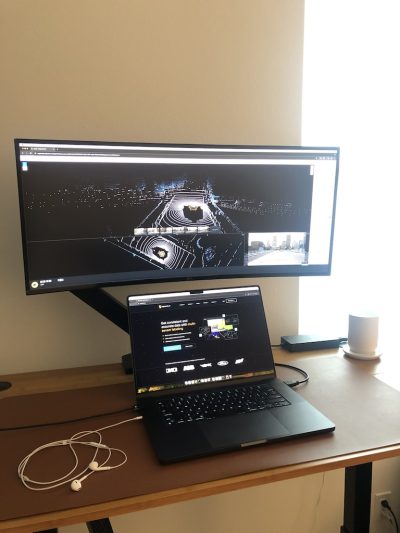 COVID broke out during my time at Appen, so I had to transition to full-time remote work. My current setup is in a bedroom with a standing desk, a large monitor, and a laptop. While I have a window, the view could be better. My ideal home office would feature a window offering a scenic view with ample natural light, enhancing the work environment and providing a refreshing outlook for breaks.
Additionally, coffee is a crucial part of my routine. While I’m not a coffee connoisseur, I’ve grown to appreciate the art of making a consistent cup, evolving from instant to pour-over or drip coffee, and paying attention to measurements to perfect the brew. This combination of a comfortable, well-lit workspace and the ritual of making good coffee forms my ideal remote working environment.
Golf has become a significant hobby for me, especially since the onset of COVID-19, as it’s an enjoyable outdoor activity. Beyond sports, I prefer outdoor activities like hiking and camping, and I’ve had a passion for motorcycles, even participating in amateur races with my Honda CBR 600 RR.
Additionally, I delve into e-commerce projects, where I enjoy analyzing and conceptualizing products. For example, when I sold ice cube packages online, inspired by occasional drinks and the appeal of large ice cubes like those used in bars.