In our first team spotlight, we introduce Mark Hafner, the new Senior Account Executive at Segments.ai. His decision to join Segments.ai? A fascination with the ever-expanding fields of robotics and autonomous vehicles and the belief that these industries will further flourish.

I told her that we are a platform that helps robots and self-driving cars to learn. AI is becoming increasingly popular in everyday culture, but the general population doesn’t know the process that goes into it. The data collection, the labeling, and the training.
Segments.ai is the platform where people can label different items. For example, for robots to be self-driving, they need the ability to “know” what is in their surrounding. So, on Segments.ai, you annotate 100 times “this is a stoplight” and feed it to the machine learning algorithm. And then again, on Segments.ai, you can check if the 101th time it understood it correctly. And if not, you correct it till it gets it right every time.
The 2D labeling was intuitive right off the bat, especially with tools like Autosegment and Superpixels.
But the 3D labeling was challenging at first. I initially struggled with perfecting the positioning of cuboids in the 3D scene, but then I discovered the efficiency of using the back side view and top view for adjustments.
The real game-changer, though, was the image overlay in 3D scenes. While point clouds alone can sometimes be ambiguous, overlaying them with a 2D image helps identify the exact object. For instance, distinguishing a truck in the point cloud became simpler when I could refer back to its image. It’s a blend of using the image to confirm what you’re labeling and the point clouds to shape it. With some guidance and continued use, I realized just how user-friendly and effective the platform is.
Just yesterday, I met with a company revolutionizing the real estate game by using robots to construct houses. Imagine the skeletal frame of your future home built by a machine! While humans still handle the interiors, it’s a concrete example – no pun intended – of robots scaling construction. It’s eye-opening.
My experience in tech sales, notably in cybersecurity, was already cutting-edge, but the robotics arena pushes even beyond that curve. It’s not just about self-driving cars or household gadgets like the Roomba anymore. We’re talking about automated lawnmowers and robotic arms in agriculture, picking grapes from vines. It’s both exciting and a bit mind-blowing.
The pandemic really switched up the game for sales. I was an outside salesperson, driving from meeting to meeting until 2020 came along. That transition was a revelation in terms of efficiency; I found that I could close deals far more effectively working from home.
When it comes to Segments.ai’s remote-first culture, it aligns well with my focus on efficiency. I do miss the camaraderie of a physical office, but then again, I used to commute three hours daily. Time I can now use more productively.
But, I am eagerly looking forward to opportunities like conferences where I can engage with the team face-to-face.
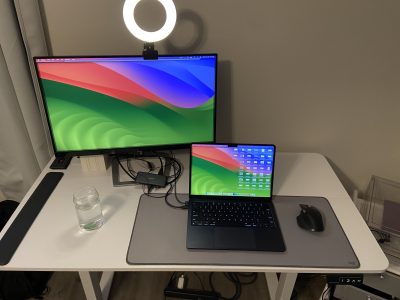
As for my home office, I’m in the process of upgrading. My initial setup was my fiancée’s old high-school furniture—hardly the ergonomic standing desk setup I aimed for! Today, I have a standing desk that allows me to move around throughout the day. Additionally, I also got an ergonomic Logi MX Masters mouse. I have installed a studio lamp to ensure I look my best in any Zoom call.
Two pieces of content come to mind. First, there’s a book called “Gap Selling“. The central thesis is that instead of pushing a product, you should focus on identifying the ‘gap’ between a potential customer’s current and desired future state. The aim is to tailor the sale around bridging that gap. It’s a shift towards solutions-based selling, which resonates strongly with me.
Secondly, there’s a podcast I regularly tune into called “30 Minutes to President’s Club“. It’s a goldmine of insights, tackling a wide range of challenges, specifically in tech sales.
Both of these resources have been enlightening in shaping my approach to client relationships and solution-based selling.
Outside of work, I’m a huge hockey enthusiast. I grew up playing ice hockey, but I’ve shifted to roller hockey these days.
On the geekier side, I’ve recently developed a keen interest in geography. It may sound unusual, but I find myself scrolling through Google Maps, just learning where things are—especially European geography now that I’m with Segments.ai.
I’d choose teleportation, no doubt. I love the idea of travel—the exploration, the culture, the scenery—but I absolutely dread the hassle of airports and flights. Imagine the possibility of snapping my fingers and spending a weekend in a European city and then jetting off to an island for some beach time. Teleportation would make that dream a reality!