Tom’s journey began with a PhD in computer vision and machine learning at KU Leuven. That’s where he met Bert for the first time, one of the founders of Segments.ai. During his PhD, Tom did a stint at Ford Motor Company in Silicon Valley, where he worked on autonomous navigation, specifically indoor 3D localization. After completing his PhD, Tom joined Flanders Make, focusing on advanced robotics and computer vision projects.
What are some of the most interesting computer vision projects you worked on?
I’ve been fortunate to work on several interesting computer vision projects over the years. During my PhD I worked on 3D geometry processing in AI. For instance, I trained a neural network to estimate depth in images, which helped a quadrotor drone avoid obstacles autonomously.
At the Ford Motor Company in Silicon Valley, I was part of the research team for autonomous navigation and 3D localization. We tackled the challenges of locating robots in indoor environments using camera images, combining modern AI techniques with traditional methods to achieve precise localization.
Another fascinating project was at Flanders Make, where I worked on automating defect detection using a robotic arm with a mounted camera. The system would perform a full scan of an object, and then use AI to detect defects. What made this project exciting was the challenge of integrating dynamic camera movements with robotic control, allowing the robot to autonomously inspect various sides of an object.
What are you currently working on at Segments.ai?
One of the thing that sets you apart in machine learning is the quality of your dataset. The common saying “garbage in, garbage out” perfectly captures this. Ensuring high-quality datasets requires rigorous data curation. However, as datasets grow larger, it becomes increasingly difficult to identify edge cases and errors. And companies rely on data curation tools such as those by Voxel51.
However, when you discover new edge cases in your data using FiftyOne, you often need to annotate additional samples for model retraining. Or when you detect a mistake in annotations, they need to be re-annotated. Today, there is a barrier to do so. That’s why Segments.ai now integrates seamlessly with FiftyOne.This integration will close the loop of identifying and correcting issues in datasets, making data annotation more efficient.

Having worked on so many computer vision projects, do you have experience with data annotation?
Yes, I’ve dealt with data annotation, especially during my time at Flanders Make. For simpler machine learning applications, we often used CVAT, an open-source annotation tool. However, for more complex projects, we turned to Segments.ai’s platform, which offers a more sophisticated and user-friendly solution.
One example where Flanders Make used Segments.ai is the FARAD2SORT ICON project in collaboration with Pfizer. This project focuses on making deep learning more accessible for engineers who aren’t AI experts; by automating repetitive but complex quality inspection tasks; and developing robots that can recognize and handle objects. It includes creating annotated datasets, retraining models automatically in unexpected situations, and optimizing performance, all through vision-based applications using 2D images.
Annotation can be quite tedious, as I’ve experienced firsthand. I remember working with a client at Flanders Make. We would often get caught in a loop where, after realizing we needed more data, we’d have to decide who would take on the next round of annotations. It usually ended with each person trying to avoid the tedious task.
Eventually, we started using specialized annotation services, and it was impressive to see how quickly they could handle the workload, especially when given clear instructions on what needed to be labeled. It highlighted the value of using dedicated services over having engineers annotate data themselves, which can be time-consuming and detracts from their core tasks.
How do you see data labeling evolving in the field of robotics and autonomy?
I see data labeling in robotics and autonomy evolving along two major trends:
The first one is the increasing use of cameras and vision systems. Vision is becoming increasingly crucial in robotics and autonomous systems, with more cameras being integrated into these technologies. This is driving a need for more sophisticated multi-sensor data labeling to handle the growing volume and complexity of visual data.
Next to that, is the rise of foundation models, like the Segment Anything Model (SAM) and larger transformer models. These models are typically trained on vast, general datasets and then fine-tuned for specific applications. They represent a strong technological shift because they allow for multimodal integration—combining different data sources, such as images, LiDAR, and radar, into a single AI system. This integration improves the overall accuracy and functionality of autonomous systems by processing diverse information streams within one coherent framework, rather than treating each data type separately.
Foundation models are particularly transformative because they are versatile and generalizable, serving as the backbone for various applications. With the capacity to integrate multiple data types directly into AI processes, these models are set to redefine how we approach complex tasks in robotics and autonomy, making them more efficient and capable of handling a wider range of environments and scenarios.
Segments.ai is a fully remote company. How is that working out for you?
Initially, I was concerned about losing contact with colleagues, but we’ve managed to stay connected through regular chats and meetings. I enjoy the flexibility of remote work, which allows me to visit my partner and work from different locations without any issues.
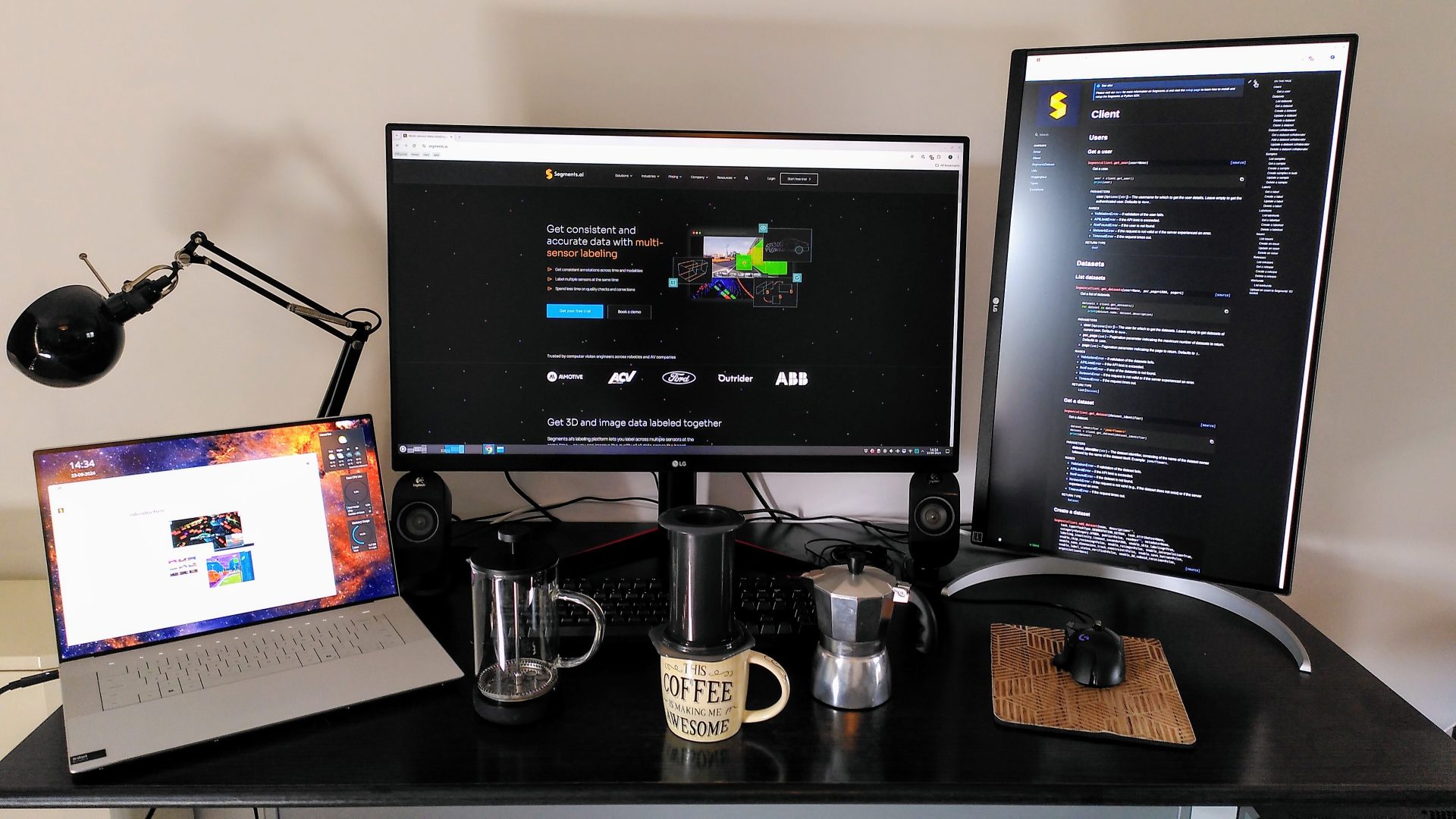
My desk is in my living room, equipped with a docking station and two screens. I’ve recently started using a vertical screen, which is ideal for viewing source code.
I also use a mechanical keyboard for a better typing experience. I prefer a tidy setup that I can quickly put away when needed.
Working from home gives me the time to enjoy my coffee ritual. I have three different brewing methods at my desk and a bean grinder in the kitchen, so I can start each day with freshly ground coffee. It’s a bit of a passion of mine, and I hear coffee is a shared enthusiasm at Segments.ai. I usually stick to local roasters, even if they’re a bit pricier—it’s worth it for the quality. I know some of you have explored some rarer and more unique beans, so I’m excited to share recommendations!