

Latest updates on Segments.ai and data labeling

Customizable Hotkeys and more
First things first: we’re happy to introduce you to our first employee Tobias who joined our team end of August. Off to a great start, the credit for our latest feature is all his! Introducing customizable hotkeys You know what’s even better than hotkeys? Customizable hotkeys. Many of you requested this [...]

Automated Labeling Workflows with Webhooks
Summer break or not, we keep shipping new features at Segments.ai. Our highlight for this month is the release of the new webhook functionality, which makes it even easier to set up automated labeling workflows. Introducing webhooks Webhooks are automated messages sent to your server when something happens. You can use [...]
Better Reviewing and QA with Issues
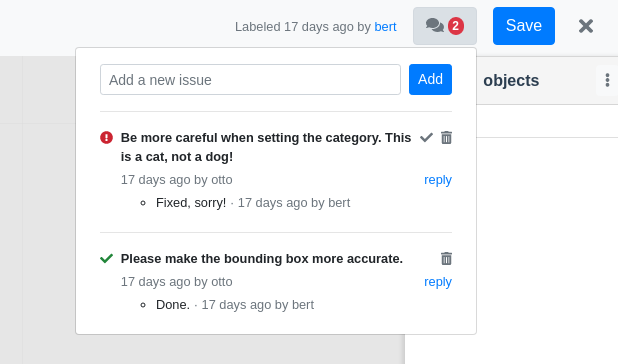
This month, Segments.ai saw lots of improvements regarding labeling functionality, developer experience and documentation. Our highlight in this update is the release of a much-requested feature to keep track of issues. ? Issues functionality With this new feature, reviewers can create an issue when they discover labeling mistakes in an image. [...]

Speed up your Image Segmentation Workflow with Model-Assisted Labeling
A large dataset of labeled images is the first thing you need in any serious computer vision project. Building such datasets is a time-consuming endeavor, involving lots of manual labeling work. This is especially true for tasks like image segmentation where the labels need to be very precise. One way to drastically speed [...]

Deploying PyTorch on AWS Lambda
Deploying PyTorch models cost-efficiently in the cloud is not straightforward. While GPU-accelerated servers can deliver results in real-time, they are quite expensive. CPU-only servers on the other hand are cheaper, but lack performance due to the computation intensive nature of deep learning. Serverless functions like AWS Lambda provide a good alternative, making up [...]

